© Johnson & Johnson and its affiliates 2026.
09/26 US-SFM-8050
Bipolar II Disorder: An Underrecognized Condition
Introduction
Bipolar disorder is a complex, heterogeneous psychiatric condition whose accurate and timely identification, particularly in primary care settings, remains an unmet need for patients. Many individuals with bipolar disorder remain undiagnosed for years after symptoms emerge or may be misdiagnosed with major depressive disorder (MDD), which may lead to inappropriate or inadequate treatment and overall poorer outcomes.1,2 Bipolar disorder is divided into two primary types by the Diagnostic and Statistical Manual of Mental Disorders (DSM-5).3,4 Bipolar I disorder is defined by the occurrence of a single manic episode lasting ≥7 days with the potential to lead to hospitalization. Mania in bipolar I disorder may also cycle with depressive episodes.4 Bipolar II disorder is defined by at least 1 hypomanic episode lasting ≥4 consecutive days and at least 1 major depressive episode lasting ≥2 weeks.4 With education and awareness, primary care providers can help play a critical role in the identification and management of people living with bipolar II disorder.5
Bipolar II Disorder Overview
Bipolar II is comprised of both depressive and hypomanic episodes, though depressive episodes dominate the clinical presentation. The DSM-5 criteria for a major depressive episode (MDE) in bipolar II are identical to the criteria for an MDE in MDD; therefore, the two conditions may be indistinguishable if a patient presents clinically during a depressive episode.6
Illness time in patients with bipolar II disorder7
Long-term weekly symptom status; mean 13.4-year follow-up (N=86)
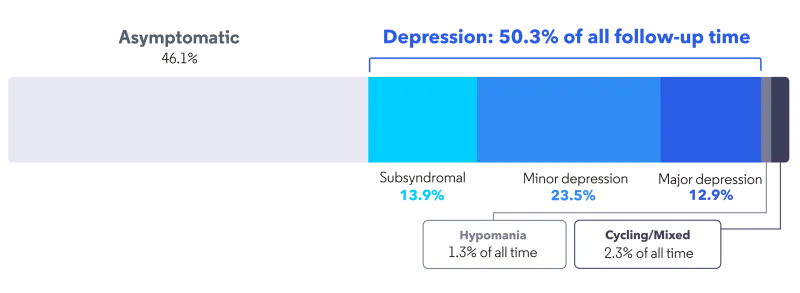
Patients with bipolar II may often first seek care for depression. Across the overall course of bipolar II, this is the mood episode that patients spend the majority (82%) of their time in.8 Additionally, some patients may not even consider certain symptoms of hypomania to be inherently negative/disruptive.6
Examples of possible hypomanic symptoms4
- Irritable mood
- Increased energy/activity
- Distractibility
- Decreased need for sleep
- Racing thoughts
- More talkative
- Inflated self-esteem
It is important to note that the symptoms of hypomania are usually not severe enough to cause marked impairment in social or occupational functioning or to necessitate hospitalization. They are more subtle and less severe than what would be present in a fully manic episode.4
Real-world data reveal that patients with bipolar II experience depressive symptoms 39 times more than hypomanic symptoms, accounting for approximately half of all follow-up time.7 This underscores the importance of recognizing the depressive presentations of bipolar II.4
Examples of possible depressive symptoms4
- Depressed mood
- Anhedonia, or loss of interest or pleasure
- Weight changes
- Insomnia or hypersomnia
- Psychomotor agitation
- Fatigue
- Feelings of worthlessness or excessive guilt
- Diminished ability to concentrate, indecisiveness
- Recurrent thoughts of death or suicide, a suicide plan, or a suicide attempt
Risk factors for bipolar II can include both genetic and physiological factors. Approximately one-third of individuals with bipolar II disorder report a positive family history, suggesting that genetic factors may contribute to the pathophysiology of bipolar II.4 It is, therefore, critical in the primary care setting to take an extensive family and social history to identify patients who may be at an increased risk.
For primary care professionals, awareness of the common presentation and characteristics of bipolar II can help support timely and accurate recognition, potentially preventing diagnostic delays and a challenging journey for patients.
Bipolar II Disorder Misdiagnosis and Unmet Needs
Studies show that patients may experience a delay of up to 10 years in receiving an accurate bipolar II diagnosis,6 with 25% of those misdiagnosed initially receiving a diagnosis of MDD.3,6 Patients with bipolar II primarily present with depressive symptoms and often do not identify or self-report hypomanic symptoms, as previously mentioned, which may contribute to the misdiagnosis rate.6 Additionally, existing screening tools are not validated in bipolar II disorder specifically.6 In the primary care setting, when patients present with an episode of major depression, clinicians should consider actively probing for a history of hypomania to support accurate diagnosis and appropriate management.4
Clinical Burden of Bipolar II Disorder
Approximately 83% of patients with bipolar II have at least one psychiatric comorbidity—most commonly anxiety, affecting up to 89% of these patients—and over 50% have three or more comorbidities.6 These additional comorbidities are often associated with an earlier age at onset, more complex presentation, and higher rates of suicide.9
Medical comorbidities are also common, affecting more than 90% of patients with bipolar II, the most frequent being metabolic, cardiovascular, and thyroid disorders.6 This burden may be compounded by treatment itself, as some antipsychotic medications used in bipolar disorder management have been associated with an increased risk of cardiovascular events, weight gain, and dyslipidemia.10 The presence of comorbidities can also contribute to treatment resistance.9
Lastly, the large burden of depression in bipolar II may result in serious impairment of daily functioning in both social and work settings.4
Economic Burden of Bipolar II Disorder
Bipolar II disorder represents one of the costliest mental health conditions.3 The management of bipolar disorder in the United States is estimated to total more than $202 billion.9 When looking more specifically at bipolar II, it has been observed that, in comparison to bipolar I, the economic burden is up to four times greater.11
Hypomanic episodes in patients with bipolar II are often difficult to recognize as anything other than being irritable and angry, which may delay seeking medical or psychiatric care.6 Certain symptom patterns within bipolar II—such as the co-occurrence of depressive and hypomanic symptoms—may contribute to increased health care utilization, including a younger age of onset, younger age at hospitalization, more frequent hospitalization, and a greater risk of suicide.12
Management Considerations in Bipolar II Disorder
Historically, research has been more focused on the treatment and management of bipolar I compared to bipolar II.11 The Canadian Network for Mood and Anxiety Treatments and the International Society for Bipolar Disorders guidelines note that bipolar II currently only has two FDA-approved first-line treatments.6 In contrast, bipolar I currently has several FDA-approved treatments.11 Polypharmacy is common in bipolar disorder broadly: more than 50% of patients receive three or more medications, and only ~20% are treated with mood stabilizer monotherapy.13
Notably, antidepressant monotherapy is not guideline-congruent care for bipolar disorder, given the risk of triggering a switch into hypomania/mania.6 Despite this, a 2022 retrospective analysis of US adults with bipolar disorder (N=40,345) found that 13.4% of patients receiving a bipolar II diagnosis were on antidepressant monotherapy as a first-line treatment.14 Current guidance for bipolar II disorder recommends combination therapy with a mood stabilizer or antipsychotic over antidepressant monotherapy.6 With few approved treatment options and increased polypharmacy, there remains an ongoing unmet need for bipolar II disorder disease management.
Clinical Impact
Bipolar II is an underrecognized type of bipolar disorder that represents an area of care with high rates of misdiagnosis and an increased clinical and economic burden for patients. Primary care plays a frontline role in helping improve the identification and appropriate management of bipolar II disorder. This may help reduce the overall burden on both patients and the health care system. The consistent assessment for the presence of hypomanic symptoms, as well as family history, in patients presenting with symptoms of depression should become an essential part of the clinical evaluation of patients in day-to-day care.5
Disclaimer
This content has been created for US health care professionals and is intended for information and educational purposes only. It should not be used to replace clinical judgment or a discussion with the patient’s health care team. All decisions regarding patient diagnosis and care must be made by a qualified health care professional based on each patient’s individual needs.
Referenced tools are adjunctive aids and are not diagnostic on their own, and this resource does not endorse or recommend any specific drug, treatment, or manufacturer.
References
- Hirschfeld RM, Cass AR, Holt DC, Carlson CA. Screening for bipolar disorder in patients treated for depression in a family medicine clinic. J Am Board Fam Pract. 2005;18(4):233-239. doi:10.3122/jabfm.18.4.233
- Keramatian K, Chithra NK, Yatham LN. The CANMAT and ISBD guidelines for the treatment of bipolar disorder: summary and a 2023 update of evidence. Focus (Am Psychiatr Publ). 2023;21(4):344-353. doi:10.1176/appi.focus.20230009
- Singh B, Swartz HA, Cuellar-Barboza AB, et al. Bipolar disorder. Lancet. 2025;406(10506):963-978. doi:10.1016/S0140-6736(25)01140-7
- American Psychiatric Association. Diagnostic and Statistical Manual of Mental Disorders. 5th ed text rev. American Psychiatric Association; 2022.
- Marzani G, Neff AP. Bipolar disorders: evaluation and treatment. Am Fam Physician. 2021;103(4):227-239.
- Swartz HA, Suppes T. Bipolar II disorder: understudied and underdiagnosed. Focus (Am Psychiatr Publ). 2023;21(4):354-362. doi:10.1176/appi.focus.20230015
- Judd LL, Akiskal HS, Schettler PJ, et al. A prospective investigation of the natural history of the long-term weekly symptomatic status of bipolar II disorder. Arch Gen Psychiatry. 2003;60(3):261-269. doi:10.1001/archpsyc.60.3.261
- Forte A, Baldessarini RJ, Tondo L, Vázquez GH, Pompili M, Girardi P. Long-term morbidity in bipolar-I, bipolar-II, and unipolar major depressive disorders. J Affect Disord. 2015;178:71-78. doi:10.1016/j.jad.2015.02.011
- McIntyre RS, Berk M, Brietzke E, et al. Bipolar disorders. Lancet. 2020;396(10265):1841-1856. doi:10.1016/S0140-6736(20)31544-0
- Nierenberg AA, Sylvia LG, Leon AC, et al. Clinical and Health Outcomes Initiative in Comparative Effectiveness for Bipolar Disorder (Bipolar CHOICE): a pragmatic trial of complex treatment for a complex disorder. Clin Trials. 2014;11(1):114-127. doi:10.1177/1740774513512184
- Yatham LN, Kennedy SH, Parikh SV, et al. Canadian Network for Mood and Anxiety Treatments (CANMAT) and International Society for Bipolar Disorders (ISBD) 2018 guidelines for the management of patients with bipolar disorder. Bipolar Disord. 2018;20(2):97-170. doi:10.1111/bdi.12609
- Shim IH, Woo YS, Bahk WM. Prevalence rates and clinical implications of bipolar disorder “with mixed features” as defined by DSM-5. J Affect Disord. 2015;173:120-125. doi:10.1016/j.jad.2014.10.061
- Ghaemi SN, Hsu DJ, Thase ME, et al. Pharmacological treatment patterns at study entry for the first 500 STEP-BD participants. Psychiatr Serv. 2006;57(5):660-665. doi:10.1176/ps.2006.57.5.660
- Jain R, Kong AM, Gillard P, Harrington A. Treatment patterns among patients with bipolar disorder in the United States: a retrospective claims database analysis. Adv Ther. 2022;39(6):2578-2595. doi:10.1007/s12325-022-02112-6